

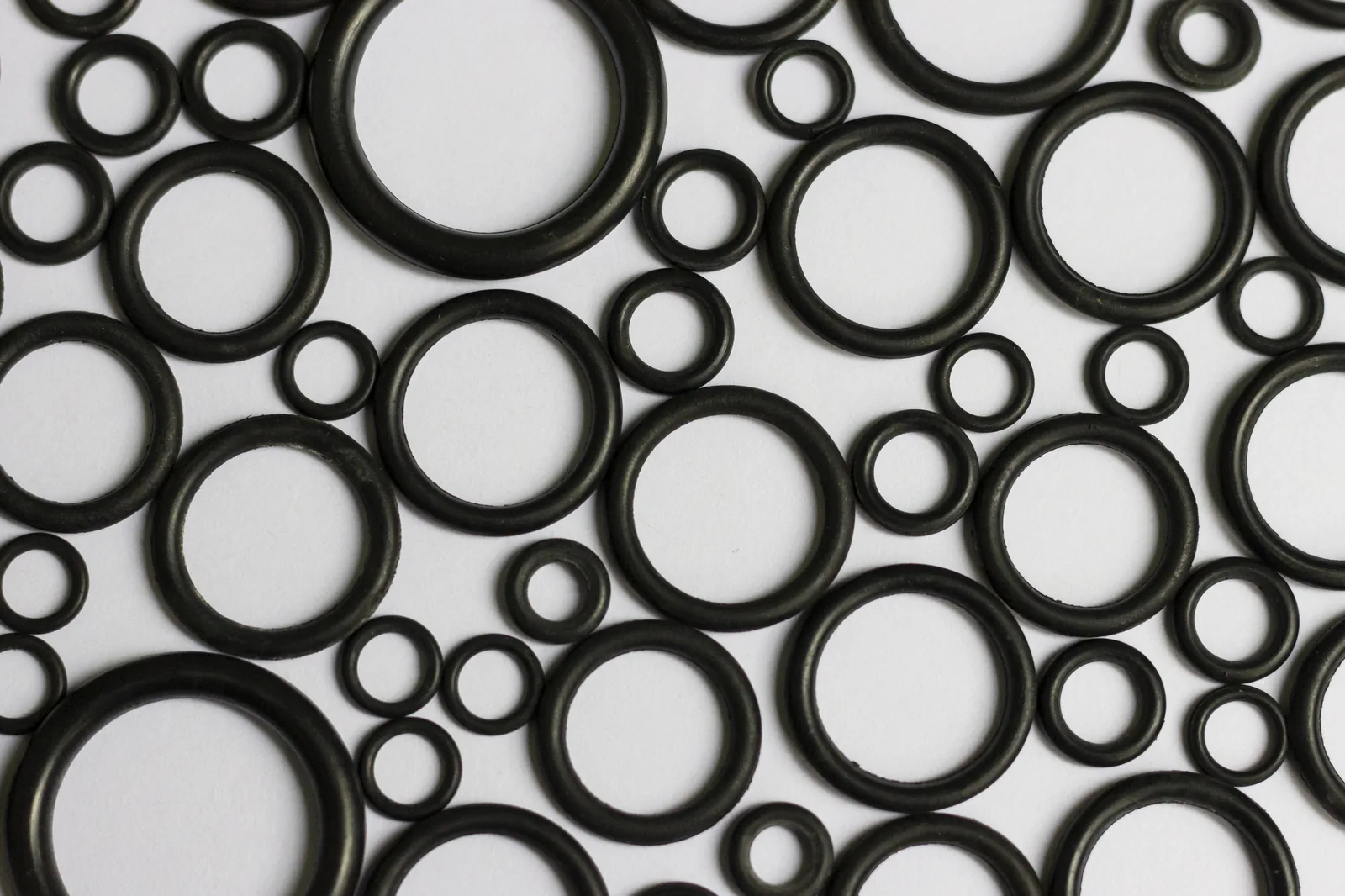
O-rings, U-cups, rod seals, piston seals, and wiper seals are not interchangeable. Each profile is designed for a specific combination of pressure direction, bore geometry, and motion type. Selecting the wrong profile produces early failure regardless of material quality.
O-rings — static and low-cycle dynamic
The O-ring is a circular cross-section seal that relies on compression between two surfaces to create a seal. It is the most widely used seal profile in industrial applications and is effective across a wide range of pressures and temperatures.
In hydraulic cylinders, O-rings are used primarily in static face seals, port connections, and gland static seals — not as the primary dynamic rod or piston seal. At high pressures and high cycle rates, the O-ring cross-section can roll in its groove, producing unpredictable wear and extrusion. For dynamic applications above approximately 160–200 bar, a profile with an anti-extrusion back-up ring, or a purpose-designed dynamic profile (U-cup or T-seal), provides greater service life.
U-cups — primary dynamic seals
The U-cup (also called a U-seal or lip seal in a hydraulic context) is the standard primary dynamic seal for hydraulic cylinder rod and piston applications. The U-shaped cross-section seals in one direction — the lip deflects against the bore or rod surface under system pressure, creating a pressure-energised seal that increases in sealing force as operating pressure increases.
Rod U-cups seal against the rod on the rod's exit stroke, preventing internal fluid from escaping. Piston U-cups seal against the bore, preventing fluid from bypassing the piston. In double-acting cylinders, two opposing U-cups are used on the piston — each sealing in its own direction.
Profile selection reference — hydraulic cylinders
| Rod seal (primary) | U-cup, single-acting. Seals internal fluid on exit stroke |
| Wiper seal | Lip seal facing outward. Excludes external contamination |
| Buffer seal | Between rod seal and wiper. Handles pressure spikes |
| Piston seal | U-cup or T-seal. Prevents bypass across piston |
| Guide ring (wear ring) | PTFE or filled polymer. Supports load, prevents metal contact |
| Static gland seal | O-ring with back-up ring. Face seal at gland |
T-seals — high-pressure dynamic
The T-seal is a T-shaped cross-section dynamic seal used in high-pressure and high-cycle applications where an O-ring would extrude and a U-cup would roll. The T-profile is stabilised in the groove by side lobes that prevent rotation and extrusion. T-seals are typically used with anti-extrusion back-up rings in applications above 250 bar.
Wiper seals — exclusion, not retention
The wiper seal (also called a scraper) faces outward from the cylinder, not inward. Its function is to remove contamination from the rod surface as the rod retracts — preventing abrasive particles, dust, and water from entering the cylinder and reaching the rod seal. In GCC cement, mining, and construction plant environments, where fine abrasive dust is present in the atmosphere, the wiper seal takes significant loading and requires a compound resistant to abrasion and UV degradation.
A wiper seal that has failed — either worn through or hardened and cracked — allows contamination to reach the rod seal. The rod seal then fails from abrasive damage rather than from any deficiency in the seal itself.
Buffer seals — pressure spike management
The buffer seal sits between the primary rod seal and the wiper. Its function is to absorb high-pressure spikes — from load impacts, end-cushion events, or rapid valve cycling — before those spikes reach the primary seal. Without a buffer seal, repeated pressure spikes fatigue the primary rod seal faster than the static operating pressure would suggest.